
Restaurant owners face a critical challenge: every unanswered phone call represents lost revenue. Industry data reveals that 83% of customers will choose another restaurant if their calls go to voicemail more than once. When your phone rings during peak hours, your staff faces an impossible choice – serve the customers in front of them or answer incoming calls.
The numbers paint a stark picture. High-demand restaurants receive between 800 and 1,000 calls monthly, yet traditional staffing models struggle to capture this revenue opportunity. During lunch and dinner rushes, phones ring while cashiers manage in-person customers and kitchen staff focus on food preparation. Each missed call can mean a lost order worth $30 to $50.
See MaYa in Action: Watch AI Handle Real Restaurant Orders
The restaurant industry has reached a tipping point with artificial intelligence adoption. According to recent Toast industry research, over half of restaurants either currently use AI or plan to adopt it in 2025—representing year-over-year growth of 7 percentage points. More telling, 79% of U.S. restaurant operators have implemented or are actively considering AI for various operational needs.
Voice AI phone ordering leads this charge, addressing universal pain points that impact every restaurant’s bottom line. The technology has matured rapidly, with voice AI accuracy rates now hitting 95% and adoption reaching 34% across the restaurant sector.
Restaurants implementing AI phone answering systems report substantial financial gains:
Real-world case studies demonstrate these returns. Dos Salsas, a 3-location restaurant in Texas, used AI phone answering to field 41,000 calls, save 308 staff hours, generate $440,000 in online sales, and book over 5,800 reservations. Local’s Pub & Pizzeria in Alaska saw a 132% increase in online orders within 90 days simply by ensuring every phone call was answered.
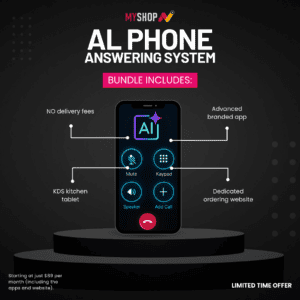
Modern AI phone systems like MaYa from MyShop Technologies operate through natural language processing that handles complete ordering conversations. When customers call your restaurant, they interact with an AI assistant that understands requests, answers questions, processes modifications, and places orders directly into kitchen systems.
AI phone ordering creates seamless interactions:
The technology handles unlimited simultaneous calls during peak hours—solving the fundamental bottleneck that causes missed revenue opportunities.
Your current phone situation likely costs more than you realize. Consider these typical scenarios:
During Rush Hours: Your team misses an estimated 5-10 calls per peak period. At 2 peak periods daily with an average order value of $40, missed calls cost $400-800 per day or $12,000-24,000 monthly.
Language Barriers: Approximately 20% of potential customers in diverse markets hang up due to communication difficulties. For restaurants receiving 500+ calls monthly, this represents 100 lost orders worth $3,000-4,000.
Order Errors: Traditional phone orders have a 25% error rate, leading to remakes, refunds, and negative reviews. These errors cost the average restaurant $800-1,500 monthly in direct costs, plus immeasurable damage to reputation and customer loyalty.
Staffing Costs: Dedicating one employee primarily to phone answering at $15-20/hour costs $2,600-3,500 monthly—before accounting for turnover, training, and benefits.
Combined, these factors easily reach $50,000+ in annual costs and lost opportunities.
MaYa represents MyShop Technologies’ purpose-built AI phone assistant for restaurants. Unlike generic voice AI systems, MaYa was designed specifically around restaurant workflows, menu complexity, and customer service requirements.
Learn more at: https://myshoptechnologies.com/maya
24/7 Availability: MaYa never takes breaks, calls in sick, or needs vacation time. Your phone is answered instantly at 3 PM on Tuesday or 8 PM on Saturday.
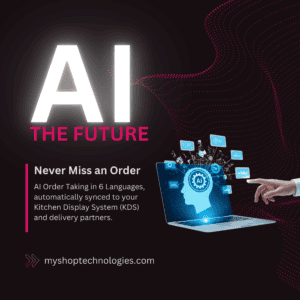
True Multilingual Communication: Supporting English, Spanish, Hebrew, Russian, Arabic, and French, MaYa switches languages mid-conversation based on customer needs—eliminating language barriers that cost orders.
Menu Intelligence: MaYa knows your entire menu, including ingredients, allergen information, preparation methods, and pairing suggestions. When customers ask “What’s in your Caesar salad?” or “Is this gluten-free?”, they receive accurate, immediate answers.
Smart Upselling: MaYa increases average order values through contextual suggestions: “Would you like to add our famous mozzarella sticks for 20% off?” or “That comes with one side—would you like fries or our loaded potato skins?”
Order Confirmation Process: Every order includes verbal confirmation of items, modifications, total price, and estimated pickup or delivery time. Orders then transmit directly to your cloud printer or kitchen display system.
MaYa integrates with existing restaurant systems:
Setup takes less than one day, with no hardware changes required beyond connecting to your existing phone line.
Major restaurant chains and independent operators alike are implementing AI phone systems:
The voice AI market for restaurants is projected to expand from $10 billion to $49 billion by 2029, reflecting proven ability to address critical industry challenges around labor efficiency and customer service.
Independent restaurants gain particular advantage from AI phone systems. While lacking the resources of large chains, they now access enterprise-level technology at accessible pricing that levels the competitive playing field.
AI phone systems typically operate on subscription models:
MaYa pricing starts at $89/month for basic implementation, with setup fees offset by 24-month commitments that often include cashback incentives.
Most restaurants achieve positive ROI within 30-60 days:
AI phone systems complement rather than replace human staff. When phones are automated, your team can focus on:
Track these metrics to evaluate your AI phone system:
“Will customers be frustrated talking to AI?”
Modern AI systems sound natural and conversational. Many customers don’t realize they’re speaking with AI. Those who do typically appreciate the efficiency and accuracy. Systems like MaYa adjust pace for elderly callers and include failsafe transfers to human staff when needed.
“What about complex orders?”
AI systems excel at complexity—confirming each modification, asking clarifying questions, and repeating order details for verification. They handle custom requests, allergy concerns, and special instructions more consistently than human order-takers under pressure.
“Can AI handle our unique menu?”
Yes. AI systems are trained on your specific menu, including seasonal items, daily specials, and preparation methods. Updates take minutes as menu items change.
“What happens during internet outages?”
Enterprise AI phone systems maintain 99.9% uptime with automatic failover systems that forward calls to traditional phone lines if connectivity issues occur.
AI phone ordering represents the beginning of broader communication transformation in restaurants. Emerging capabilities include:
Restaurants implementing AI phone systems now position themselves at the forefront of this evolution, building technological infrastructure that will support future innovations.
Consider AI phone ordering if your restaurant experiences:
The technology suits restaurants of all types—from single-location independents to multi-unit operations. Fast-casual, full-service, pizza, ethnic cuisine, and specialty restaurants all benefit from automated phone ordering.
To get started with AI phone ordering:
For restaurants ready to explore AI phone ordering, MaYa offers free demonstrations showing the system handling real ordering scenarios in multiple languages.
AI phone ordering has moved from experimental technology to competitive necessity. With over half of restaurants either using or planning to adopt AI in 2025, those who delay risk falling behind competitors who are capturing more orders, improving accuracy, and reducing costs.
The financial case is compelling: restaurants implementing AI phone systems report revenue increases up to 22%, labor cost reductions around 17%, and prevention of tens of thousands in annual losses from missed calls. More importantly, these systems free staff to focus on what humans do best—creating exceptional dining experiences that build loyal customers.
The phone problem that once seemed unsolvable—the choice between serving in-person customers or answering incoming calls—now has a proven solution. AI phone ordering answers every call instantly, takes perfect orders in multiple languages, and never takes a break.
For restaurant owners serious about growth in 2026 and beyond, the question isn’t whether to implement AI phone ordering, but how quickly you can get started.
