
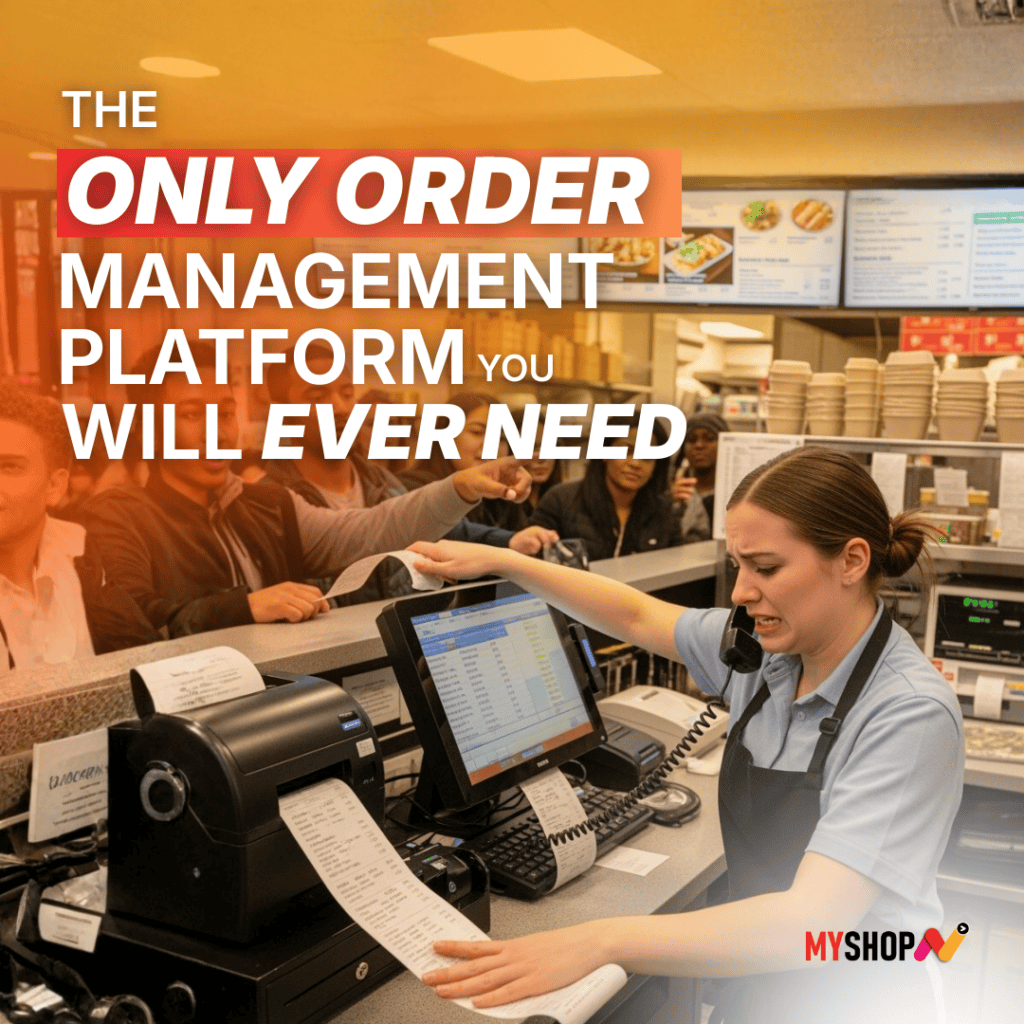
Running a restaurant in 2026 means managing orders from more channels than ever before: phone calls, your website, mobile apps, self-service kiosks, and third-party delivery platforms. Keeping track of it all without a centralized system creates chaos, errors, and lost revenue.
That’s where an order management system comes in. This guide explains what an OMS is, how it works in a restaurant environment, and what the industry data shows about its impact on operations and profitability.
An order management system (OMS) is software that centralizes and processes customer orders from multiple channels into a single platform. For restaurants, this means orders placed via phone, website, mobile app, in-store kiosk, or third-party delivery service all flow into one unified dashboard.
The system then routes each order to the appropriate destination—typically a kitchen printer or digital display screen—without requiring staff to manually re-enter information. This automation reduces errors, speeds up fulfillment, and ensures no order gets lost during busy periods.
Beyond order processing, modern OMS platforms also store customer data, track sales analytics, and integrate with payment processors and delivery logistics providers.
The typical order flow through a restaurant OMS follows several steps.
Order capture: A customer places an order through any connected channel. The OMS receives the order data in real time, including items, modifications, delivery or pickup preference, and payment information.
Order routing: The system automatically sends the order to kitchen printers or a kitchen display system (KDS). Some platforms can route different items to different prep stations based on menu category.
Fulfillment tracking: Staff mark orders as in-progress and complete. For delivery orders, the OMS may coordinate with drivers or delivery services to schedule pickup.
Customer communication: Many systems send automated confirmations, estimated ready times, and delivery tracking updates to customers.
Data collection: Throughout this process, the OMS captures information for reporting: order volume, revenue by channel, popular items, peak hours, and customer purchase history.
The shift toward digital ordering has accelerated dramatically. Industry data shows that over 40% of adults now order delivery or takeout three to five times per month. Among Gen Z consumers, 69% prefer food delivery over dining in. This volume of off-premise orders creates operational challenges that manual processes struggle to handle.
According to research from the National Restaurant Association, off-premise dining now accounts for 60% of restaurant occasions, creating unprecedented demand for efficient order management technology.
Missed orders during peak hours: When phone lines are busy and staff are stretched thin, potential orders go unanswered. Research indicates restaurants miss 20-30% of incoming calls during rush periods.
Order errors: Manual transcription from phone to kitchen introduces mistakes. Industry averages suggest phone order accuracy hovers around 60-70%, while digital orders through an OMS achieve 80% accuracy or higher.
Third-party commission fees: Delivery platforms typically charge restaurants 15-30% per order. For a restaurant processing $10,000 monthly through these platforms, that’s $1,500-$3,000 in fees. An OMS with direct ordering capabilities can recapture much of this margin.
Data from Toast’s Restaurant Success Report shows that restaurants using direct ordering channels retain an average of 23% more revenue per order compared to those relying exclusively on third-party delivery apps.
Fragmented customer data: When orders come through third-party apps, the platform—not the restaurant—owns the customer relationship. An OMS consolidates customer information for direct marketing and loyalty programs.
OMS platforms vary in capabilities. Here are the features most relevant to restaurant operations.
The core function of any OMS is bringing orders from different sources into one view. This includes web orders, mobile app orders, phone orders (increasingly handled by AI voice systems), kiosk orders, and third-party platform orders. A unified dashboard lets staff manage everything without switching between systems.
Effective order management requires seamless kitchen connectivity. Most systems support cloud-based printers that produce tickets automatically when orders arrive. More advanced setups use kitchen display systems (KDS)—screens that show orders digitally and allow staff to update status with a tap.
A growing number of OMS platforms now include AI voice technology that answers phone calls, takes orders conversationally, and processes payments—all without human intervention. These systems can handle multiple simultaneous calls and often support several languages, addressing both capacity constraints and language barriers.
According to QSR Magazine’s technology survey, restaurants implementing AI voice ordering systems report 95% accuracy rates and capture 40% more phone orders during peak hours compared to traditional phone systems.
Some order management systems integrate with delivery logistics providers, allowing restaurants to offer delivery without building their own driver network or paying percentage-based commissions. Services like Uber Direct, DoorDash Drive, and similar platforms charge flat per-delivery fees rather than taking a cut of order value.
Data visibility is a major advantage of centralized order management. Standard reporting includes sales by channel, time-of-day patterns, item popularity, average order value, and customer frequency. This information supports menu optimization, staffing decisions, and marketing targeting.
The order management software market continues to grow rapidly. Projections estimate the global market will reach $1.88 billion by 2026, expanding at a 12.6% compound annual growth rate. The Restaurant Technology Market Report from Grand View Research confirms that digital ordering systems are becoming fundamental infrastructure rather than optional upgrades, with North American adoption leading global markets. Within the restaurant sector specifically, adoption has become widespread—approximately 80% of U.S. restaurants now use some form of digital order management platform.
Studies on the impact of digital ordering consistently show higher average order values compared to phone orders. Research indicates customers ordering through apps, websites, or kiosks spend 10-30% more than those ordering directly from staff. The combination of visual menus, automated upsell prompts, and reduced time pressure contributes to larger tickets.
Restaurants implementing comprehensive OMS solutions report an average 20% revenue increase, driven by captured missed orders, higher ticket sizes, and retained delivery margins that would otherwise go to third-party platforms.
Pricing models for restaurant OMS platforms generally fall into three categories.
Flat monthly subscription: Fixed monthly fees typically range from $89-$200 depending on features included. This model provides cost predictability and doesn’t penalize growth.
Per-transaction fees: Some providers charge 2-5% of each order processed. This can be cost-effective at low volumes but becomes expensive as order counts increase.
Hybrid models: A combination of lower monthly fees plus per-order charges or fees for specific premium features.
Initial setup costs vary from $400 for basic software configuration to $1,500 or more for complex implementations. Hardware like kiosks typically costs $1,400-$2,000 per unit.
A POS (point of sale) system primarily handles in-person transactions at the register—processing payments and recording sales. An order management system focuses on aggregating orders from multiple channels (online, phone, kiosk, delivery apps) and routing them to the kitchen. Many restaurants use both, with the OMS feeding order data into the POS for unified sales reporting.
Implementation time varies by platform complexity and restaurant needs. Basic cloud-based systems can be configured in as little as one day, including menu setup and payment integration. More complex implementations involving hardware installation, multiple locations, or custom integrations may take one to two weeks.
Most modern OMS platforms are cloud-based and work with standard tablets, computers, and receipt printers. Many integrate with existing POS systems and payment processors. Before selecting a platform, verify compatibility with your current setup to avoid unexpected hardware costs.
That depends on your strategy. Third-party apps provide exposure to customers browsing their marketplaces, which can drive new customer acquisition. However, an OMS with direct ordering capabilities lets you serve existing customers without paying commissions. Many restaurants maintain a presence on delivery platforms for discovery while encouraging repeat customers to order directly.
Language support varies by provider. Basic systems may offer English only, while more advanced platforms support multiple languages including Spanish, French, Mandarin, and others. Some systems can switch languages mid-conversation based on customer preference. For restaurants serving diverse communities, multilingual capability is an important evaluation criterion.
Selecting an OMS requires matching platform capabilities to your specific operational needs. Consider your order volume, primary channels, delivery strategy, and budget. Prioritize systems that offer transparent pricing, quick implementation, and ownership of your customer data.
MyShop Technologies offers a comprehensive order management platform built specifically for independent restaurants. The system includes AI-powered phone ordering in six languages (English, Spanish, Hebrew, Russian, Arabic, and French), branded mobile apps and websites, self-service kiosks, and commission-free delivery integration. With flat monthly pricing starting at $89, over 1,000 restaurant locations, and 1% customer churn rate, MyShop provides enterprise-level capabilities at independent restaurant budgets. Learn more at myshoptechnologies.com.
visibility_offDisable flashes
titleMark headings
settingsBackground Color
zoom_outZoom out
zoom_inZoom in
remove_circle_outlineDecrease font
add_circle_outlineIncrease font
spellcheckReadable font
brightness_highBright contrast
brightness_lowDark contrast
format_underlinedUnderline links
font_downloadMark links
Reset all optionscached
